


Birmingham, Toni Morrison, and what it means to practice “Mourning as Method.”


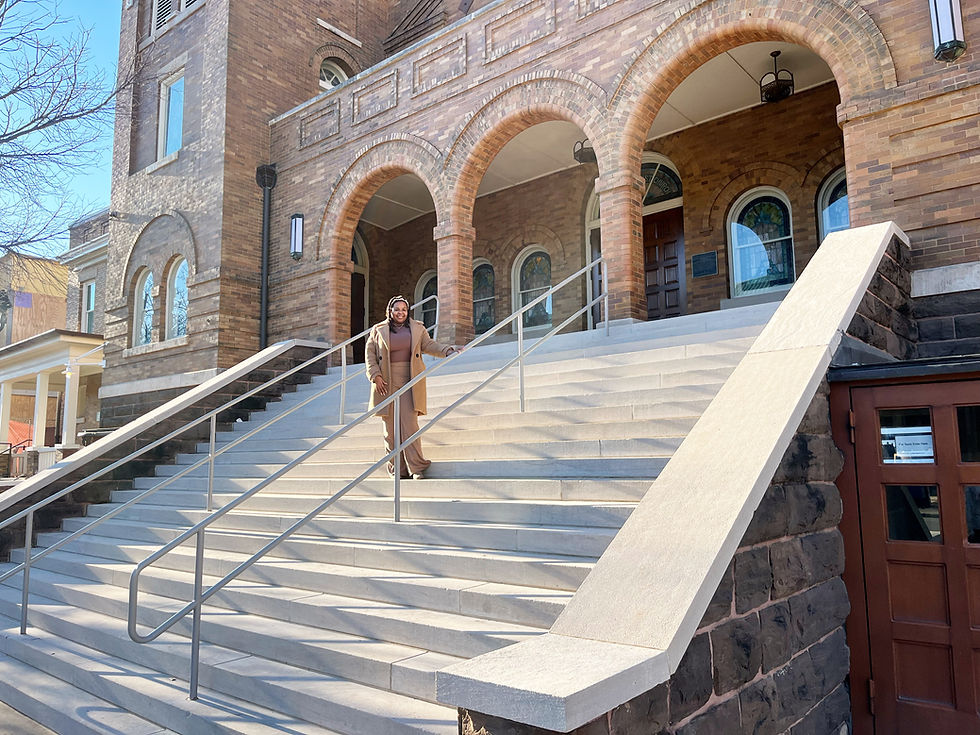
I finished my talk on February 7th standing on the steps of the 16th Street Baptist Church in Birmingham, Alabama. In a real-body way with my feet on stone, wind on my face,(yes Alabama is a bit cold) throat still warm from speaking, heart still doing that familiar thing grief makes it do: expand and ache at the same time. I had just presented my paper, “Mourning as Method: Black Feminist Griefwork, Ancestral Autoethnography, and the Beloved Community” at the 78th Annual Meeting of the Southeast Philosophy of Education Society (SEPES).And in the days around the conference, I was reading Toni Morrison’s God Help the Child. Truth be told, I have been reading this book for. little minute. I need to return it to the library.

Birmingham is one of those places that won’t let you play with language. You can’t say “community” lightly there.You can’t say “education” like it’s only about schools.You can’t say “childhood” like it’s protected by default. Because Birmingham holds the memory of how hard this country has fought to deny Black people sanctuary—how violently it has policed Black gathering, Black worship, Black joy, Black organizing, and yes, Black children.The 16th Street Baptist Church isn’t just a historic site. It is a wound that still teaches. A place where the nation tried to speak through terror and God has revealed his magnificence. And I stood on those steps knowing that the “steps” are not neutral and it made me very emotional because steps are thresholds, inside and outside as well as publicly in and the sanctuary. I could not possibly stand on those steps and remain the same.
I almost missed my tour too! So I want to give a very warma nd special shoutout to the finest tour guides I have been blessed to exchange energy with, Ms. Jackie, Ms. Joyce and both Mr. Johnathans. May God bless you all eternally! Thank you so very much for your time and attention.
In God Help the Child, you feel how Black childhood gets marked,how the world writes on children before they even know how to name what’s happening to them. You feel how shame can be inherited. How “love” can come laced with punishment. How adults can be both protection and harm. How colorism and cruelty become household air. It’s not the kind of book you read and just “enjoy.” It presses on you. And that is in part why it took me 100 business days to finish because it really isn't that long of a text. I was called to carry it and carrying it while moving through a city where the stakes of Black childhood have been brutally clear was felt in every ache and muscle in my body. These questions rang out somatically from my core What does the world demand of Black children? What does it steal from them? Who is expected to survive without tenderness?

And then my own work kept answering: We cannot talk about beloved community without talking about what has been made ungrievable. We cannot talk about “care” without telling the truth about where it has been absent. We cannot talk about education as liberation while ignoring how schools and society repeatedly rehearse disposability.
My paper is about grief, yes. But not grief as a private feeling. I’m talking about Black feminist griefwork, mourning as a way of knowing. Mourning as a practice of memory. Mourning as a form of ethical attention. Mourning as a refusal to let the dead be flattened into history’s footnotes. Mournign because it pushed, molded and shaped me as I embark on this intellectual journey in this Black woman body.

I call it “mourning as method” because I’m done pretending grief is something you do after the work. For many of us, grief is the work.
So bear with me as I share my current section II of the paper below:
II. The Mournings as Method
Mourning is often imagined as a private, interior process, something to be carried in solitude until it fades into memory. Black feminist thought offers another possibility: mourning as method, a practice that teaches, gathers, and refuses disappearance (Sharpe, 2016; Gordon, 1997). To mourn, in this frame, is not simply to grieve what is lost, but to generate forms of knowledge, community, and survival from within the rupture(Hartman, 2007; hooks, 2003). Grief, then, becomes pedagogical: as it instructs us in how to love, how to resist disposability, and how to honor the dead as part of our ongoing becoming (James, 1999; Wynter, 2003). This is how the memory of my most recent ancestors haunt the work I co-create with them in educative ways.
On September 21, four years after I brought Grandma Babe home to die on her own terms, I still experience a sort of waking when seeing the time display at 7:34 a.m. I think of the memory of her last breath, in being in community with that rupture and ascension unto ancestor (hooks, 2003). The Beloved Community, in real life, looked like cousins fumbling and showcasing grief in natural ways, ways that taught me grief is a teacher and in this classroom I could experience so much harm and hurt when family reckons with a transmutation of a love gone in the physical sense, a neighbor and elders bringing nutritious foods to ground my body through the ebb and flow, the coming and going as life would birth a new me, and me holding her hand long and strong and then gently before the room went quiet and meditating on that call because calling the funeral home felt like betraying the covenant of our care. I learned then that belovedness is not a mood; it is a choreography of bodies, time, and attention through which we keep one another from disappearing (Sharpe, 2016).You see I really can’t afford to forget my Grandma Babe. I learned to build an altar out of what we had in her experience of beloved community as Black women in relation, her church programs, her rain scarves, a bottle of perfume long evaporated, her Spelman Grandma teacup, the last few voicemails saying everything and nothing in particular at the same time. Those objects trained my pedagogy for the ways in which I attend to what remains, and let it teach me (Gordon, 1997; Hartman, 2007).
When my cousin Victor died in March 2024,by suicide following brain tumor surgery,I was traveling home from a Philosophy of Education Society (PES) conference, preparing to return to a toxic workplace. The news arrived like a rupture across multiple registers: grief, fatigue, and a dawning sense that life as I knew it could not continue unchanged. Weeks prior, I would also learn that I had been accepted into my doctoral program, a new beginning braided inextricably with loss like no other. Mourning, then, did not halt my intellectual life but it pushed me to creatively embody the ways I would have to design it or rather restructure it. It taught me that my scholarship could not be divorced from grief, that theory and mourning were not opposites but collaborators (James, 1999; Dillard, 2012). My literal experience as a Black woman in Philosophy and Education began in the muddy waters of grief, and it has been my greatest teacher cushioned between joy, faith and authenticity (Collins, 2000; Hartman, 2007).
Grandma Babe’s passing had already schooled me in how to attend to death with dignity, bringing her home, refusing institutional abandonment, watching over her body as the family gathered around. Victor’s death was a different kind of lesson: that mourning also happens in transit, between all the academic conferences and workplaces, that it intentionally interrupts the flow of “professionalism” and cracks open the illusion of separation between academic life and personal loss. My scholarship, my teaching, and my mothering are now haunted by these scenes as knowledge itself is not some sort of impediment to productivity but the impetus of this ancestral and divine purpose.
See for me, grief teaches me what matters. What trains my attention and organizes my ethics as well as remind me that love is not only a feeling—it’s a responsibility. And when I bring in ancestral autoethnography, I’m telling the truth about how I write and why.

I don’t write from a distance.I write with my lineage close.
My grandmothers. My ancestors. My people. My students. My child. My community. My body as archive. My life as data. My voice as testimony. And I hold on tight to it. Because I am in a field that challenges me to create distance with the work often. But so much of the work I reclaim is energetic, memory retrieval and refusal, living in the otherwise where threshold meets theory meets blood memory.
The beloved community isn’t “nice.” It’s disciplined love. People love to quote “beloved community” like it’s a vibe, and maybe it is. But it isn't soft music and unity bracelets and everyone holding hands at its core. The beloved community—if it means anything real—has to be sturdy enough to stand in places like Birmingham and not turn away.Beloved community is not harmony baby it is commitment.
It is how I am committed to come to SEPES as well as NEPES and PES. It is how I am committed to the authenticity of my voice and scholarship.It’s the choice to practice care when institutions don’t. Shout out to Grandma Babe being essentially forced out of nursing at 75 because of new technologies. (It is a bit more nuanced then just that but that is in part what is going on.) It’s the choice to tell the truth when silence would be easier. It’s the choice to remember what the world tries to erase. It’s the choice to make a shelter out of each other. I am a girl's girl and you have no idea what this trip meant to me to stand on such sacred ground.

But again it was a confrontational time, as it’s also the choice to ask hard questions:
What do we owe Black children beyond symbolism?
What does it mean to protect Black innocence without romanticizing it?
What does “safety” mean when the world has historically made Black gathering unsafe?
How do we teach and lead without reproducing the same coldness we claim to resist?
Beloved community is a practice. Period. It’s how you show up.It’s how you share power.It’s how you keep people from disappearing... and of course reading this book and being in this place, I thought about my block girlhood and my own child.
I’m a mother. So I can’t stand at 16th Street Baptist Church and keep it academic.
I can’t talk about “the child” like it’s theoretical. I thought about the girls who died there. I thought about the Sunday shoes, the stained glass, the laughter that should’ve been allowed to grow up. I thought about the futures that were stolen and the mothers who had to keep living anyway. And I thought about my own baby who is not even 10 yet. I thought about how Black motherhood is often made to feel like a constant negotiation with the world: How do I raise a child in a nation that has never been fully committed to her safety? How did I survive? Back to commitments, I know I will not let this world teach my child that she is disposable. I will not let my classroom become a place where children learn they must shrink to survive. I will not let “achievement” become more important than humanity.
I’m bringing back:
A deeper seriousness about what it means to say “care.”
A sharper refusal of empty language.
A renewed commitment to teach like people’s lives matter—because they do.
A reminder that grief is not weakness; grief is love with nowhere to go, and love is power.
And I’m bringing back a question I want to live inside for a while:
What does it mean to be a scholar whose work is not only written—but practiced? Because that’s what Birmingham asked of me. Be accountable to the dead.Be accountable to the living.Be accountable to the children. Don't just present your little theories and run.
If you’re reading this…

If you’ve been grieving anything—someone, a version of yourself, a lost season, a broken promise, a betrayal, a dream deferred—I want to say this plainly: You are not behind.
You might be in the middle of your method. Your grief might be teaching you what no syllabus ever could. And if you’re committed to building beloved community—at home, in the classroom, in your friendships, in your leadership—please know:

It won’t always look pretty.
But it can be holy.
And it can be real.
I’m still processing Birmingham. Still hearing my own voice bounce off those walls. Still feeling the weight of that church in my chest. But I know this much: I didn’t just visit history.
History visited me back. And it asked me to keep going.
I will be writing more...as I process.
Shout out to #BenitoBowl


Comments