


What I Carried to PES: Black Feminist Reflections on Philosophy, Memory, and Becoming

Attending the Philosophy of Education Society conference this year felt like more than a professional milestone. It felt like way more urgent than usual. Like, I got in an argument the night before and the day of. Ruptures and reckoning always remind me that this is bigger than me, and this needs me. What is the reminder? A reminder that ideas matter, yes, but also that the people carrying them matter too. And let me tell you, at any given moment, in any given time, I may be prone to go off in the transition into Spring. The bodies, histories, griefs, longings, and lineages that walk with me into conference rooms as I am carrying papers, prayers, and possibilities, and even pauses. Are these pauses nervous tensions and anxieties? Maybe. Are the pauses moments of deja vu? Maybe. Either way, now and then, as I navigate in the rapture of my becoming, I have to pause and be. It is quite amazing now when I look back on this pattern, because in reality it is not a long time, it is fractions of seconds.

To attend PES as a Black woman scholar, as a teacher, as a mother, and as someone whose intellectual life is inseparable from lived experience, is never a neutral thing. Like, I literally got into an argument right before driving down. There is so much of me that remains unseen in this world of being a scholar mama. And now a partner at the time. Most times, I feel like a pressure cooker, and I cannot say that I am enjoying this pressure and feelings of tension. I do not arrive at these spaces untouched by the world. If I do sound like a broken record in repeating this, then that is the risk I have to be willing to take because too often Black women are further dehumanized and dissociated from their bodily experiences in their scholarship and navigations in higher education institutions and communities. So when I come through... I arrive having survived it, studied it, taught through it, and tried to imagine beyond it. I arrive with my ancestors. I arrive with my students. I arrive with the memory of home. I arrive with questions that are not merely academic, but urgent: What does it mean to learn in the wake of loss? What might education become if we took memory, place, grief, and community more seriously and as philosophical grounds? These are my Black Feminist Reflections on Philosophy, Memory, and Becoming.
That was the paper, that is the work right, returning and recalibrating to this theme of grief and loss as the greatest markers of love and life. This year at PES, I had the opportunity to present work that sits very close to my spirit. In one session, I reflected on rootedness, loss, and learning in the wake of homegoing. In another, I explored the idea that my house is a school—that place, memory, and community are not peripheral to philosophy, but central to it. These presentations were not just papers to me, and if you know me by now then you would understand that they were offerings. They were part of a larger intellectual and spiritual practice of insisting that the lives we come from, the people who shaped us, and the communities that made us are worthy of theory, worthy of method, and worthy of philosophical attention. (Next blog post, we will talk about Dana and how I feel like Dana from the book Kindred)

Wait, I forgot to tell ya'll I came to this conference with my fiance, my daughter, and my dog. We stayed in this little airbnb and we stayed for four days in Pittsburgh, PA. They also came to the session, yes everybody even the dog, because we were cutting it close with time and there was no room to sort out the logistics of split activities last minute like that. But anyway...
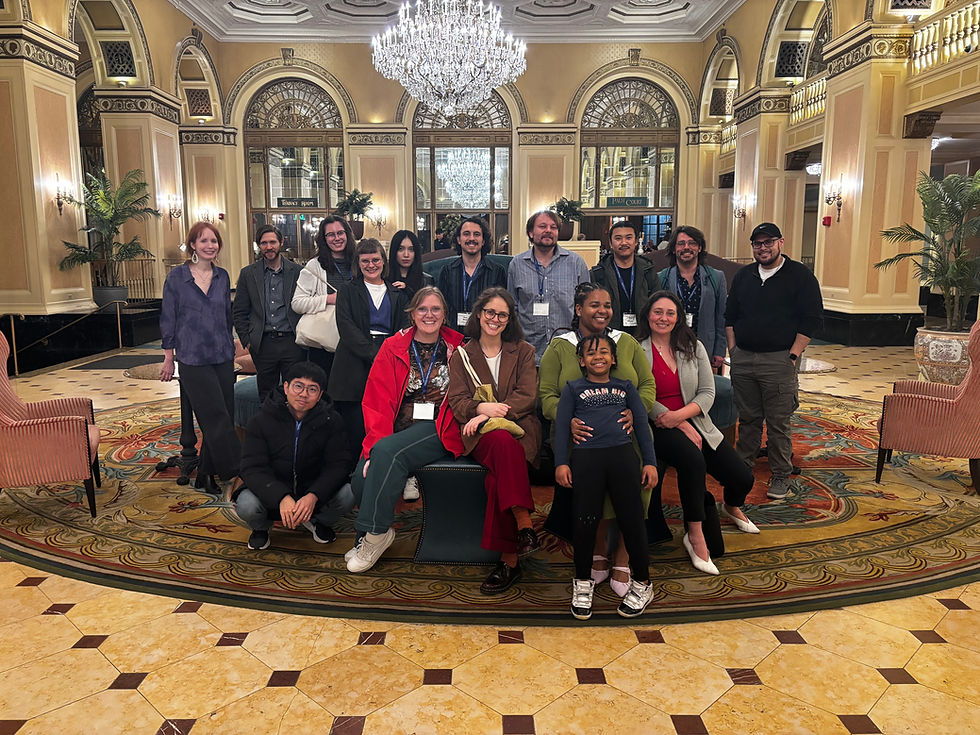
There is something powerful about speaking work aloud in a room of people who care about education, ethics, justice, and the making of worlds. And yet, conferences can also be strange spaces. They can hold brilliance and limitation at once. They can be affirming and alienating, generative and exhausting. For me, attending PES is never just about presenting polished ideas. It is also about noticing what kinds of knowledge are welcomed, what kinds are questioned, and what kinds still have to fight to be heard. It is about asking what philosophy of education is willing to make room for. I was pleased and surprised that so many people came to my little session, like the room I was speaking in was filled. My advisor also came to support and listen, and that was nice. Along with some people, I have built relationships over the years. I was so shocked to take up the space I did take up, for example, when I was reading my paper, I was reading fast, thinking I only had twenty minutes, only to find out I could read the whole paper if I wanted to. The crowd insisted. So I did.

What I carried with me throughout the conference was a deep sense that Black feminist thought continues to offer a necessary intervention into educational philosophy. In a rigorous and world-making intellectual tradition not a “supplement” or “identity add-on”. A way of knowing that takes embodiment seriously. A way of thinking that refuses abstraction without accountability. A way of studying education that understands survival, care, memory, contradiction, and liberation as deeply pedagogical matters. Again, I almost lost my nerve in coming because your girl experienced last minute compounded stress and plain ole, screw all of this. I am burnt. But still I rise, and my fiancé also agreed to put ego aside for a moment and drive.

I also left the conference thinking about community. Not networking in the shallow sense, but a real scholarly community—the kind that nourishes, sharpens, and steadies you. I am so incredibly grateful to experience the work-in-progress sessions. That is really where the community has a nice opportunity to blossom. The kind that reminds you that your work is not developing in isolation. That there are others wrestling with language, power, history, coloniality, freedom, and the fragile task of becoming more human together. I loved hearing about ideas and how special we are in giving some contours to these ideas. In a time when so many of us are carrying private and public burdens, that kind of gathering matters and I truly do not take it for granted. I am grateful to have met and connected with Gray and Mylo during this time, who have made a delightful impression on my time at this particular PES.


Attending the PES Annual Conference for the 4th time further affirmed for me that my work is not too personal. It is not too embodied. It is not too Black, too spiritual, too rooted in home, too attentive to grief, too committed to the lives of ordinary people. Or maybe it is, but here I am anyway. If anything, these are the very grounds from which my scholarship must emerge. I am increasingly uninterested in forms of academic performance that require disembodiment to be taken seriously. I want a philosophy of education capacious enough for mourning, beauty, memory, refusal, and Black life. I want a scholarship that does not ask us to sever ourselves from the truths that formed us.
Closing this chapter of PES 2026, I feel especially grateful to have presented “In the Wake of Homegoing: Rootedness, Loss, and Learning” and “My House Is a School: Place, Memory, and Community as Public Philosophy,” two pieces that reflect the heart of my scholarly commitments: grief, memory, Black life, place, and the educational wisdom carried in ordinary and sacred spaces. To also receive the PES Legacy Award felt profoundly affirming—not simply as recognition of a single paper, but as acknowledgment of the kind of work I am trying to do in the world. Work that is rigorous and rooted. Theoretical and lived. Intellectual and ancestral. As a Black woman scholar, mother, teacher, and thinker, that moment reminded me that the work I carry, and the worlds I come from, belong in the philosophical conversation.

So I leave PES grateful. Grateful for the chance to present. Grateful for the conversations that stretched me. Grateful for the reminder that my voice belongs in these rooms. And grateful, too, for the growing clarity that my work is not simply about contributing to a field. It is about helping remake its terms. Because education, for me, has always been more than schooling. It has been survival. Ceremony. Inheritance. A way of naming the world otherwise.
And that is the work I remain committed to.


Comments